The Enterprise Generative AI Roadmap (2025-2026): From Pilot Purgatory to Agentic ROI
Move from AI pilots to production. Our 2026 Enterprise Generative AI Strategy guide covers agentic AI, ROI frameworks, and secure scaling for CTOs.
MindLink AI Blog Team
P1
In the early months of 2026, the honeymoon phase of "GenAI experimentation" has officially ended. For the modern CTO and Innovation Lead, the mandate has shifted from proving that Large Language Models (LLMs) work to proving they deliver a measurable impact on the P&L.
Developing a robust Enterprise Generative AI Strategy is no longer about procuring seats for a chatbot; it is about re-architecting the enterprise to support autonomous action. At MindLink Systems AI, we have observed that the leaders winning this race are those who have moved away from "app-centric" AI to "workflow-embedded" intelligence.
The State of Enterprise AI in 2026: The "Great Split"
As of January 2026, we are witnessing the "Great Split" in the corporate world. On one side, 72% of organizations are still struggling with "Pilot Purgatory," where AI initiatives fail to move past the Proof of Concept (PoC) due to data silos, hidden "Shadow AI" costs, and a lack of clear governance. On the other side, a 7% elite group of "AI-Native" firms have fully integrated AI into their operational DNA, realizing productivity gains of over 24%.
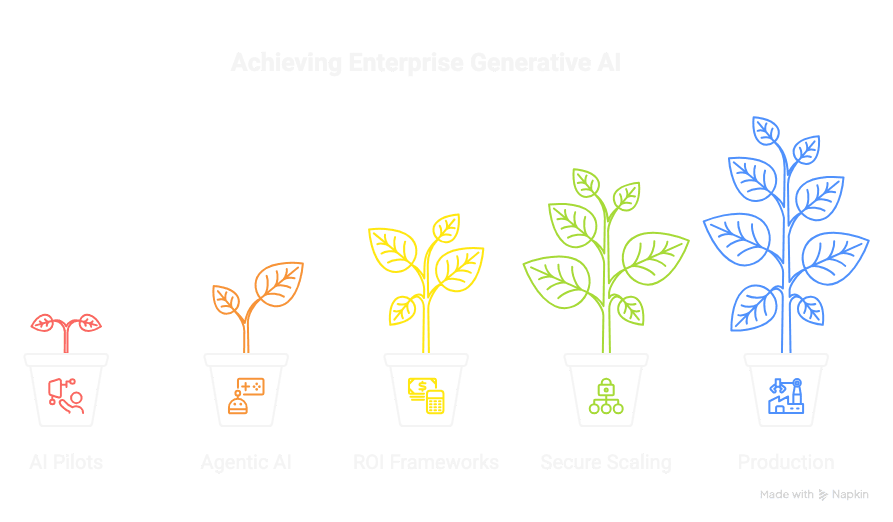
To join the latter, your roadmap must transition through five critical phases of maturity.
Phase 1: Foundation – Aligning Strategy with Business Intent
A successful Enterprise Generative AI Strategy begins with a ruthless prioritization of use cases based on "Strategic Intent." We categorize these into four quadrants:
Efficiency: Reducing OpEx through high-volume task automation (e.g., Customer Service, Document Processing).
Growth: Driving new revenue streams via hyper-personalized product offerings.
Resilience: Strengthening risk management and compliance monitoring.
Experience: Enhancing both employee and customer satisfaction through intuitive AI interfaces.
The 90-Day Execution Blueprint:
Days 1–30: Conduct an AI tool audit to identify "Shadow AI" and map high-risk data boundaries.
Days 30–60: Select one high-value workflow and move it to production-grade deployment.
Days 60–90: Build the initial AI governance steering committee to oversee ethical alignment.
Phase 2: The Data & Architecture Layer – Building for Scale
In 2026, data debt is the leading cause of AI project failure. Scaling requires moving beyond monolithic stacks toward modular, API-first architectures.
Beyond RAG: Modular Architectures and Model-Aware Compute
While Retrieval-Augmented Generation (RAG) was the gold standard in 2024, the enterprise now requires Agentic RAG. This involves models that don't just "retrieve and summarize" but "reason and verify."
To support this, your technical stack must accommodate:
Hybrid Operating Patterns: Fluid routing of compute across private clouds and the edge to manage latency.
Model-Aware Compute: Allocating GPU resources dynamically based on task complexity (e.g., using a small model for summarization and a frontier model for complex reasoning).
Phase 3: The Shift to Agentic AI – Automating Outcomes, Not Tasks
The defining trend of 2026 is the pivot from chatbots to Autonomous AI Agents. Unlike standard LLMs that require constant human prompting, these agents can plan, use tools, and execute multi-step workflows independently.
Key Statistic: Gartner predicts that by the end of 2026, 40% of enterprise applications will include task-specific AI agents.
This shift requires a fundamental change in how we view the workforce. We are moving toward a Human-AI Hybrid Operating Model, where AI handles repetitive execution and humans focus on strategy, exception handling, and ethical oversight.
Phase 4: Measuring the Unmeasurable – The New GenAI ROI Framework
Traditional ROI metrics often fail to capture the value of AI. At MindLink, we use a multi-dimensional formula to quantify success:
$$ROI_{Total} = \frac{(Direct\ Savings + Revenue\ Lift + Capacity\ Gains) - (Implementation + Compute + Governance\ Costs)}{Investment}$$
Direct Savings: Reductions in manual labor hours (e.g., 15-25% cycle time reduction).
Revenue Lift: Increases in conversion rates or faster time-to-market.
Capacity Gains: The "Invisible ROI"—the value of work that couldn't have been done without AI.
Phase 5: Governance & Ethics – The Trust Anchor
As AI gains more autonomy, the risk of "Agentic Abuse" or data leakage grows. A secure Enterprise Generative AI Strategy must include:
Post-Quantum Readiness: Protecting data against future cryptographic threats.
Explainability Requirements: Ensuring every AI-driven decision in sensitive sectors (Finance, Healthcare) is auditable.
Human-in-the-Loop (HITL): Maintaining a strict protocol where humans authorize high-stakes actions.
Related Articles