Step-by-Step Guide: Moving from AI Pilot to Full-Scale Production
Stop the PoC cycle. Learn the 5-step framework for scaling GenAI, from building AI gateways to implementing production-grade Eval frameworks.
MindLink AI Blog Team
C1.2
The jump from a successful demo to a production-ready system is the most treacherous phase of any Enterprise Generative AI Strategy. In a pilot environment, "hallucinations" are a curiosity to be discussed; in production, they are a liability that can erode customer trust or result in significant financial loss.
At MindLink Systems AI, we've found that scaling AI isn't just about adding more compute—it's about shifting from stochastic experimentation to deterministic engineering. This guide outlines the rigorous framework required to graduate your AI initiatives from the lab to the core of your enterprise operations.
The "PoC Chasm": Why 80% of AI Pilots Fail to Scale
Most pilots fail to reach production because they are built as "silos." A pilot often uses a clean, static CSV file and a single API key. Production, however, requires the model to interact with messy, real-time data, varying user intents, and strict latency requirements.
To cross this chasm, you must stop treating AI as a standalone "app" and start treating it as a distributed system component.
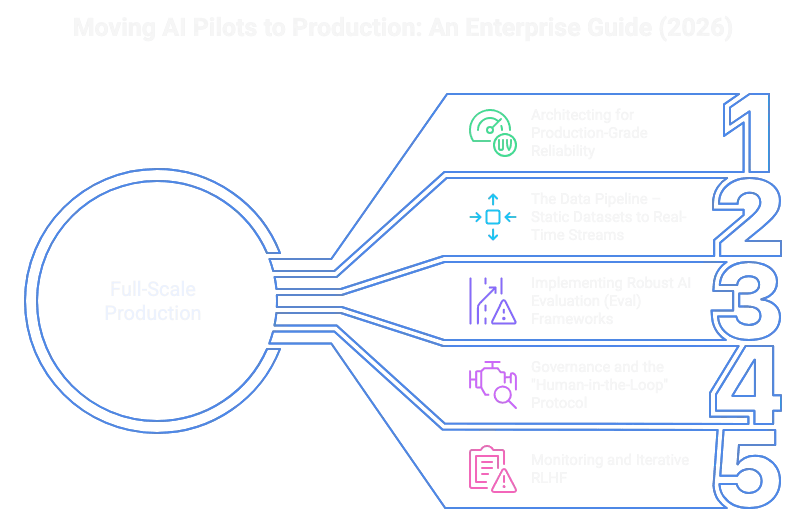
Step 1: Architecting for Production-Grade Reliability
In a pilot, you likely hit a public endpoint (like OpenAI's gpt-4). In production, you need an abstraction layer.
Transitioning from Playground APIs to Enterprise Gateways
You must implement an AI Gateway. This is a middleware layer that handles:
Rate Limiting: Ensuring one runaway script doesn't deplete your monthly token budget in an hour.
Fallback Logic: If your primary model (e.g., Claude 3.5) experiences downtime, the system should automatically reroute to a secondary model (e.g., GPT-4o) without the user noticing.
Cost Tracking: Attributing AI spend to specific departments or product features.
Step 2: The Data Pipeline – From Static Datasets to Real-Time Streams
A production model is only as good as the context it receives. Moving to scale requires transitioning from "Manual RAG" to Dynamic Context Injection.
Your production data pipeline must handle:
Vector Database Scaling: Ensuring your retrieval system (like Pinecone or Weaviate) can handle thousands of concurrent queries with sub-100ms latency.
Permission-Aware Retrieval: Ensuring the AI only "sees" documents the specific user is authorized to view. This is a critical security step often missed in pilots.
Step 3: Implementing Robust AI Evaluation (Eval) Frameworks
How do you know your model is "good enough" for your customers? "Vibe checks" don't scale. You need a quantitative Eval Framework.
In production, we use a scoring matrix:
Faithfulness: Does the answer stay true to the retrieved documents?
Relevance: Does it actually answer the user's prompt?
Latency: Is the Time to First Token (TTFT) within the acceptable threshold (typically < 2 seconds for chat)?
Pro Tip: Use "LLM-as-a-Judge" where a larger, more capable model (like GPT-4o) audits the outputs of your production model (like Llama 3) based on defined rubrics.
Step 4: Governance and the "Human-in-the-Loop" Protocol
Scaling your Enterprise Generative AI Strategy requires a safety net. For high-stakes industries (Finance, Healthcare, Legal), you cannot remove the human entirely.
Implement a Tiered Automation Model:
Tier 1 (Low Risk): Fully autonomous (e.g., internal document summarization).
Tier 2 (Medium Risk): AI generates, Human reviews/edits (e.g., draft emails to clients).
Tier 3 (High Risk): AI suggests, Human approves (e.g., credit limit decisions or medical advice).
Step 5: Monitoring and Iterative RLHF
Once live, the work isn't done. Production AI requires Observability. You need to track "Model Drift"—the phenomenon where the model's performance changes as real-world data evolves.
Use Reinforcement Learning from Human Feedback (RLHF) in production by adding "Thumbs Up/Down" buttons to every AI interaction. This data should be fed back into your fine-tuning pipeline every 30–90 days to continuously improve the model's alignment with your specific business logic.
Checklist: Are You Ready for Full-Scale Production?
Requirement | Status | Description |
Identity/Auth | [ ] | Is AI access tied to our SSO (Okta/Azure AD)? |
Rate Limiting | [ ] | Can we prevent a "DDOS" of our API budget? |
Sanitization | [ ] | Are we scrubbing PII before it hits the model? |
Latency | [ ] | Is the end-to-end response time under 5 seconds? |
Legal | [ ] | Have we updated our ToS to include AI-generated content? |