Secure Enterprise AI Implementation: The Definitive Guide to Data Privacy in the Age of LLMs
Master Secure Enterprise AI Implementation. Learn how to protect PII, meet GDPR/HIPAA standards, and deploy private LLMs with MindLink Systems AI.
P3
By January 2026, the primary inhibitor of AI adoption is no longer a lack of capability, but a concern for security. While Large Language Models (LLMs) offer unprecedented productivity, they also introduce a new surface area for risk. For the modern C-Suite, a Secure Enterprise AI Implementation is the only bridge between a vulnerable pilot and a production-grade asset that protects the organization’s "Crown Jewels."
At MindLink Systems AI, we recognize that "safety" is not a static checkbox. It is a multi-layered architectural commitment. As organizations shift toward agentic workflows, the movement of data across model boundaries requires a "Zero Trust" approach. If your data is the fuel for your competitive advantage, then security is the engine that ensures that fuel never leaks.
The Security Imperative: Why 2026 Is the Year of "Hardened" AI
The era of "unfiltered" API calls to public models is coming to an end. In 2025, we saw a 40% rise in data exposure incidents caused by "Shadow AI"—employees inadvertently training public models on proprietary corporate strategy or customer PII.
A successful Secure Enterprise AI Implementation must solve the paradox of the "Black Box": how to leverage the reasoning of a global model without surrendering the privacy of local data. This requires moving away from generic cloud wrappers toward a hardened, private infrastructure where the model comes to the data, rather than the data going to the model.
Mapping the Threat Landscape: From Prompt Injection to Data Leakage
Traditional cybersecurity tools are often blind to the semantic vulnerabilities of LLMs. To secure an enterprise environment, we must defend against three primary vectors:
Direct & Indirect Prompt Injection: Malicious instructions disguised as benign queries or hidden within retrieved documents (RAG) that trick the model into exfiltrating data.
Model Inversion & Membership Inference: Sophisticated attacks designed to "reverse-engineer" training data from the model’s responses.
Third-Party Dependency Risk: The vulnerability of the "Agentic Supply Chain," where a breach in a connected CRM or ERP API compromises the AI agent.
The MindLink Security Architecture: Four Layers of Defense
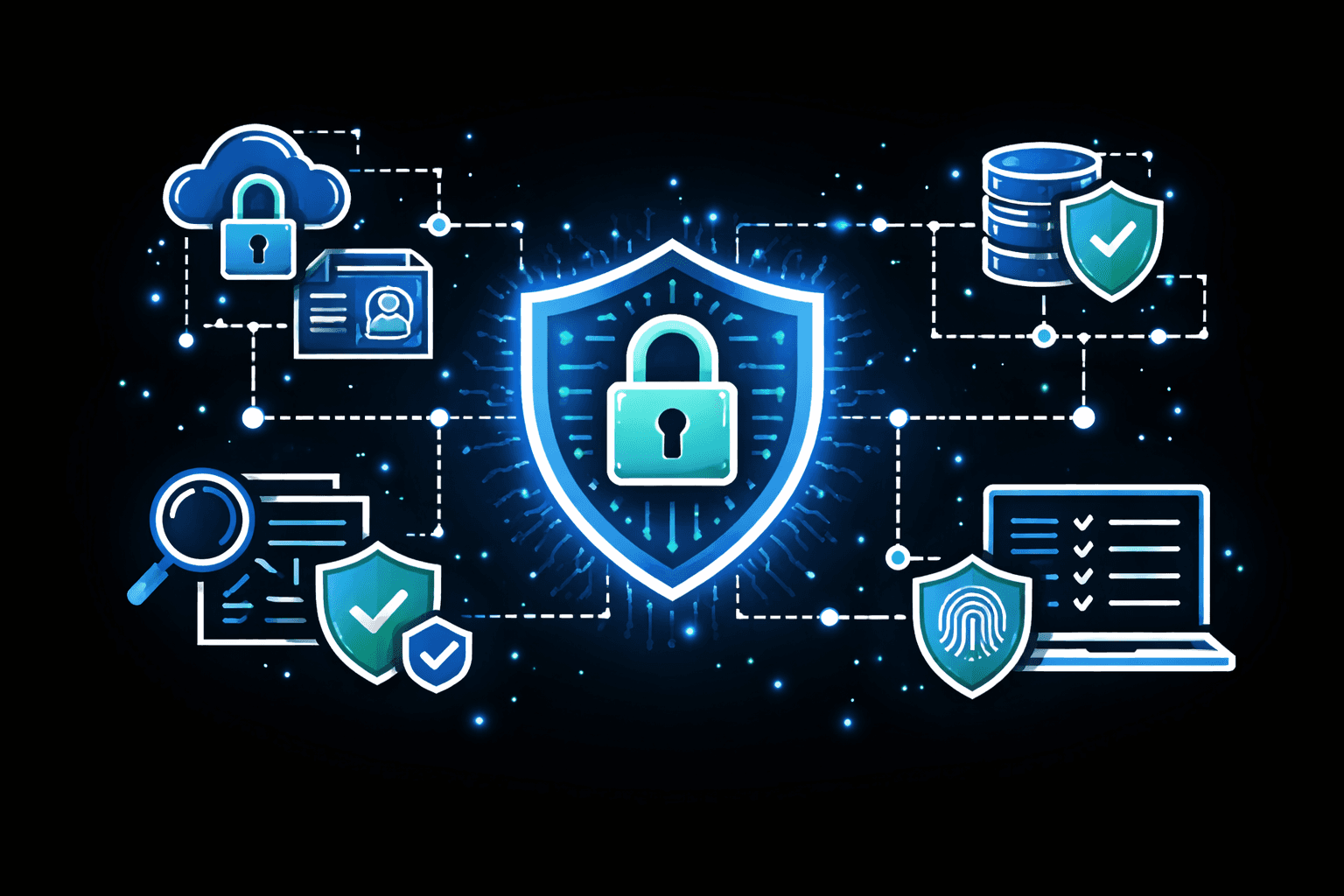
Our framework for Secure Enterprise AI Implementation is built on a "Defense-in-Depth" strategy.
Layer 1: Data Sovereignty & Infrastructure
The foundation of security is location. By utilizing Private LLM Deployment (on-premise or within a dedicated VPC), we ensure that data residency requirements are met. Your data never touches the public internet, and your model weights are protected within Trusted Execution Environments (TEEs).
Layer 2: Real-Time PII Masking and Anonymization
Before a query ever reaches the reasoning engine, it passes through a "Privacy Scrubber." This layer utilizes Small Language Models (SLMs) to identify and redact Personally Identifiable Information (PII) in real-time, replacing it with secure tokens that can be "re-hydrated" only after the model provides its response.
Layer 3: Model-Level Guardrails
We implement "Dual-Model Architecture" where a secondary, deterministic model audits every input and output. If the auditor detects a prompt injection attempt or a response that violates corporate policy, the transaction is terminated instantly.
Layer 4: Post-Quantum Readiness and Encryption
With the threat of "Harvest Now, Decrypt Later," we utilize Post-Quantum Cryptography (PQC) to secure the communication channels between your AI agents and your internal databases, ensuring that today’s data remains safe against tomorrow’s compute power.
Regulatory Alignment: Navigating the EU AI Act, HIPAA, and GDPR
In 2026, compliance is no longer a suggestion—it is a mandate. A Secure Enterprise AI Implementation must provide a clear audit trail that satisfies the world’s most stringent regulators.
GDPR: Ensuring the "Right to be Forgotten" can be enforced even within a vector database.
HIPAA: Maintaining strict "Business Associate" protocols for AI agents handling protected health information.
EU AI Act: Implementing the "Transparency Stack" required for high-risk AI applications, including model cards and human-in-the-loop logs.
Building a Culture of AI Governance: Beyond the Technical Stack
Technical guardrails are only effective if paired with human oversight. Our approach includes the development of an AI Ethics Framework, which establishes:
Accountability: Defining who "owns" the decisions made by an autonomous agent.
Transparency: Ensuring that AI-driven outcomes are explainable to both employees and customers.
Continuous Monitoring: Monthly "Red Teaming" exercises to stress-test the system against evolving adversarial tactics.