3 Real-World Examples of Generative AI Solving Operational Inefficiency
See how leaders use Enterprise Generative AI Strategy to solve supply chain bottlenecks, manufacturing defects, and compliance hurdles in 2026.
C1.4
In 2026, the market is no longer impressed by AI that can "write a poem." Enterprise leaders are now laser-focused on AI that can "fix a supply chain." As organizations refine their Enterprise Generative AI Strategy, the focus has shifted from general-purpose assistants to specialized, high-impact agents designed to eliminate deep-seated operational friction.
The following case studies represent the vanguard of this shift. They demonstrate how mid-market and enterprise firms are moving beyond "chat" to build systems that reason, act, and optimize in high-stakes environments.
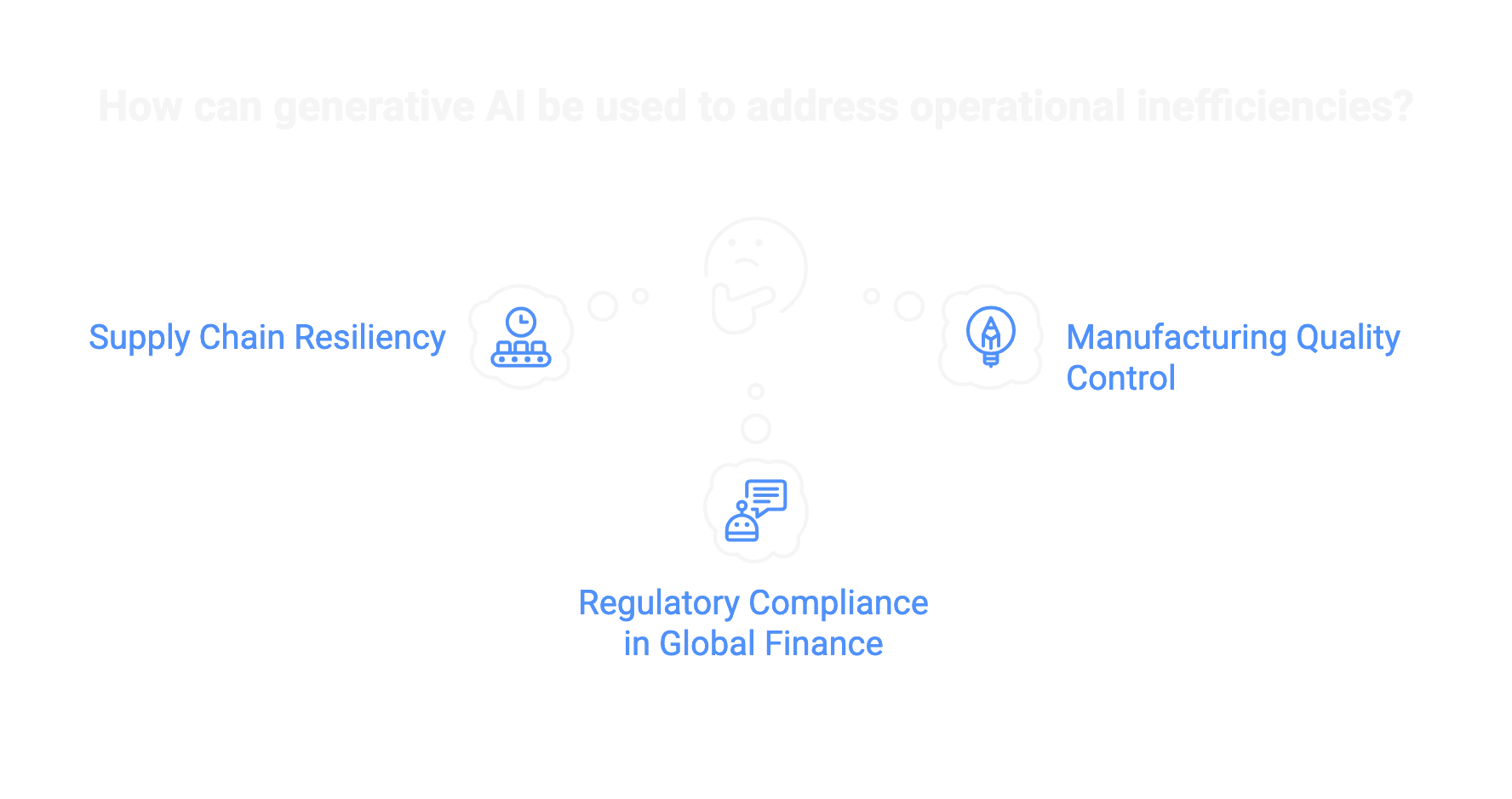
Case Study 1: Transforming Supply Chain Resiliency via Autonomous Negotiation
A leading US-based multi-national retailer faced a chronic "Information Gap" in their procurement process. With over 5,000 suppliers, human procurement officers were physically unable to negotiate terms for "tail spend" items—the thousands of low-value, high-volume components that keep a business running.
The Problem: The "Email Bottleneck"
Manual negotiation resulted in static contracts that didn't account for real-time market volatility. This led to overpayment during supply surges and stockouts during shortages.
The AI Solution
The retailer implemented an Agentic AI system designed to monitor global shipping data, commodity prices, and warehouse inventory levels. Using a custom-tuned LLM, the agent was authorized to:
Initiate automated email negotiations with "Tier 3" vendors.
Adjust order volumes based on real-time demand sensing.
Confirm delivery windows without human intervention.
The Result: The company reported a 40% improvement in demand forecasting accuracy and reduced the average negotiation cycle from 14 days to just 3 seconds. By automating the "tail," procurement leads were freed to focus on high-value strategic partnerships.
Case Study 2: Manufacturing Quality Control at the Edge
A Tier-1 automotive parts manufacturer was struggling with a 4.5% scrap rate on their high-precision assembly lines. Traditional machine vision systems were too rigid, failing to identify "novel" defects that didn't match a specific pre-programmed template.
The Solution: Vision-Language Models (VLMs) at the Edge
As part of their broader Enterprise Generative AI Strategy, the manufacturer deployed Edge AI vision systems. Unlike traditional systems, these VLMs use "Zero-Shot Learning" to understand what a "good" part looks like vs. a "bad" part through natural language descriptions.
The Implementation:
Latency-First Design: Inference was performed on-site (On-Premise) to ensure the 2ms response time required by the assembly line.
Continuous Learning: When the system flagged a "borderline" part, a human supervisor provided a natural language correction (e.g., "This scratch is cosmetic, not structural"), which the model used to update its reasoning in real-time.
The Result: The plant achieved a 35% reduction in scrap and a 42% improvement in labor productivity within the first 90 days of full production.
Case Study 3: Automating Regulatory Compliance in Global Finance
A mid-sized European investment bank was drowning in the "Compliance Tax." With the introduction of more stringent 2025 AI and data regulations, the bank’s legal team was spending 60% of their time manually reviewing cross-border transaction logs for potential PII (Personally Identifiable Information) leaks.
The Shift: From Manual Audits to Real-Time Monitoring
The bank deployed a Private LLM within a secure VPC (Virtual Private Cloud) to act as an "Autonomous Auditor."
RAG-Powered Auditing: The system was connected to the bank's internal policy "Knowledge Base" via Retrieval-Augmented Generation (RAG).
Agentic Redaction: The AI didn't just flag issues; it proactively redacted sensitive data and generated "Compliance Summaries" for the regulatory board.
The Result: The bank realized a 60% reduction in compliance document review time. Most importantly, the system provided an audit trail that was 100% compliant with the new AI Act, shielding the bank from potential fines that could have reached 7% of global turnover.
Analysis: The Common Thread in Successful AI Deployments
Across these diverse sectors, the organizations that moved successfully from pilot to ROI shared three characteristics in their Enterprise Generative AI Strategy:
They Picked an "Anchor" Workflow: They didn't try to "fix everything." They targeted specific, measurable bottlenecks (Negotiations, Scrap, Compliance).
They Prioritized Data Sovereignty: Whether at the Edge or in a Private Cloud, they ensured their proprietary operational data never touched the public internet.
They Embraced "Human-in-the-Loop": They used AI to augment experts, not replace them, leading to higher adoption rates and faster iterative improvements.