On-Premise vs. Private Cloud: Which AI Deployment is Right for Your Business?
Compare on-premise vs. private cloud for your Enterprise AI. Learn about data sovereignty, GPU neoclouds, and the ROI of cloud repatriation in 2026.
C1.3
In the landscape of 2026, the question of where your models reside has evolved from a technical detail into the cornerstone of your Secure Enterprise AI Implementation. As generative AI moves from "chat" to "agency"—where models autonomously access internal databases and execute transactions—the perimeter of your data has never been more vulnerable.
For the modern CTO, the choice between on-premise and private cloud is no longer just about cost; it is about Data Sovereignty. If your AI strategy relies on sending proprietary IP to a public API, you aren't just renting intelligence—you are exporting your competitive advantage.
The Infrastructure Crisis of 2026: Why Architecture is Now a Security Pillar
As predicted, 2025 and early 2026 saw a surge in "Cloud Leakage" incidents where multi-tenant public environments inadvertently exposed training data through prompt injection vulnerabilities. Consequently, at least 15% of enterprises have begun "AI Repatriation"—moving critical workloads back to controlled, single-tenant environments.
A Secure Enterprise AI Implementation now requires a "Zero-Trust" approach to the model itself. The infrastructure you choose determines whether you can enforce air-gapped security or if you remain dependent on a provider’s "shared responsibility" model.
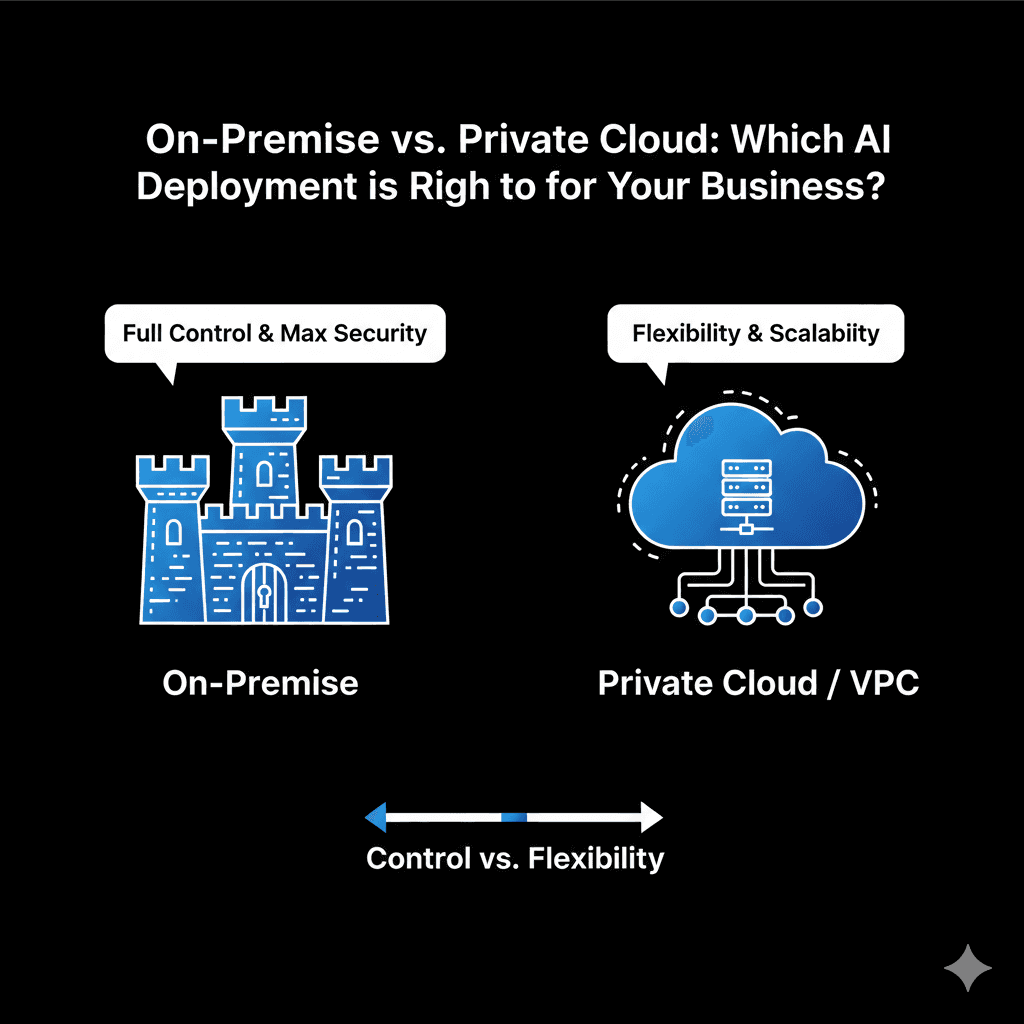
On-Premise AI: The "Vault" for Sovereign Intelligence
On-premise deployment involves hosting your GPUs (typically NVIDIA H200s or B200s in 2026) and your model weights within your own physical data center.
Absolute Sovereignty: Data never leaves your network. This is the gold standard for industries like Defense, Healthcare (HIPAA), and high-stakes Finance.
Predictable Performance: Zero "noisy neighbor" syndrome. You have 100% of the compute power 100% of the time.
Customization: You can optimize the hardware stack (liquid cooling, specialized interconnects) specifically for your model's architecture.
The Economics of On-Premise: CAPEX vs. Recurring Token Taxes
While the upfront CAPEX for on-premise hardware is high, the "Token Tipping Point" is real. For organizations running steady-state inference (24/7 automation), an on-premise server typically breaks even against public cloud costs within 14 to 18 months. Beyond that, your marginal cost per query is essentially the cost of electricity.
Private Cloud AI: Balancing Elasticity with Isolation
Private cloud (or Virtual Private Cloud - VPC) offers a middle ground. You utilize dedicated, isolated resources within a cloud provider's infrastructure.
Managed Security: You benefit from the provider's physical security and SOC2 compliance while maintaining logical isolation.
Speed to Deployment: You can spin up a dedicated GPU cluster in minutes rather than waiting months for hardware procurement.
Scalability: When you need to retrain a model, you can "burst" into additional dedicated nodes without purchasing permanent hardware.
The Rise of the "Neocloud": GPU-First Providers for the Mid-Market
In 2026, we've seen the emergence of "Neoclouds" (e.g., Lambda, CoreWeave). These providers offer specialized, GPU-native private clouds that are often more cost-effective and flexible for AI than the "Big Three" hyperscalers.
Technical Comparison: Latency, Governance, and Control
Feature | On-Premise | Private Cloud (VPC) | Public AI API |
Data Privacy | Absolute (Air-gapped) | High (Single-tenant) | Low (Multi-tenant) |
Latency | < 10ms (Local Network) | 20ms - 50ms | 100ms+ |
Governance | Full Control | Auditable / Policy-based | Provider Dependent |
Maintenance | High (In-house team) | Medium (Managed) | Low (SaaS) |
The Hybrid Reality: Implementing a Multi-Tiered Deployment Strategy
Most successful Secure Enterprise AI Implementations do not pick just one. They use a Hybrid AI Architecture:
Tier 1 (Internal Secrets): On-premise. Used for fine-tuning models on sensitive R&D, legal strategy, and PII-heavy datasets.
Tier 2 (Operational Scale): Private Cloud. Used for customer-facing agents that require high availability and the ability to scale during peak traffic.
Tier 3 (Commodity Tasks): Public Cloud. Used for non-sensitive tasks like translating public marketing copy or summarizing general news.
Decision Matrix: Choosing Your Secure AI Foundation
Choose On-Premise if: You have high, predictable inference volumes; you handle ultra-sensitive data; or you require sub-10ms latency for industrial automation.
Choose Private Cloud if: You need to move fast; your workloads are "bursty" (e.g., seasonal scaling); or you prefer an OPEX-heavy budget model.
Choose a Hybrid Approach if: You want the security of on-prem for your "crown jewels" but the elasticity of the cloud for your growth initiatives.