5 Workflows You Should Automate with AI Agents Today
Drive 2026 growth with Custom AI Agents for Business. Explore 5 autonomous workflows for sales, supply chain, and HR that move beyond simple chatbots.
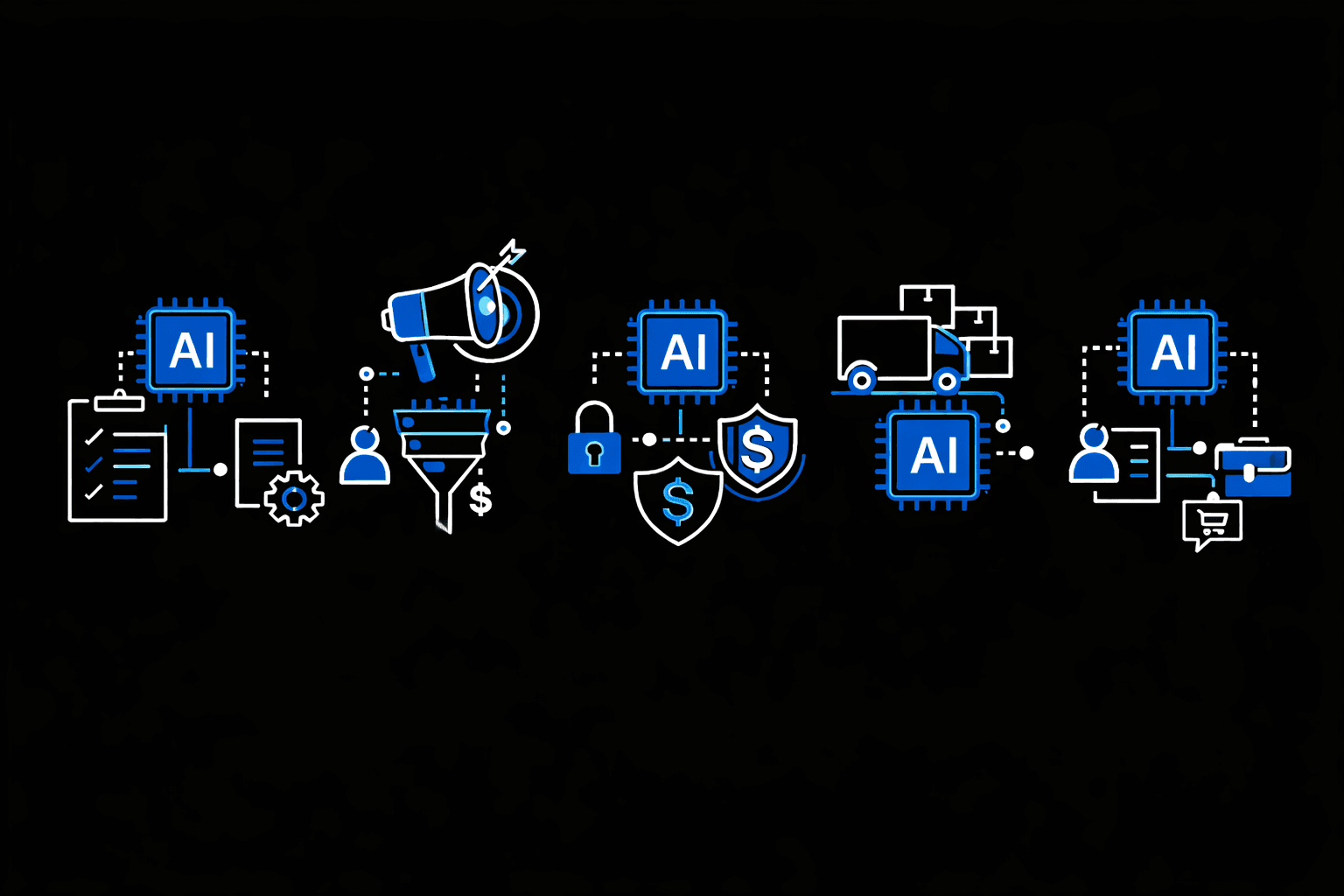
C2.1
In the fast-evolving landscape of 2026, the competitive gap is no longer defined by who uses AI, but by how much autonomy that AI is granted. While many firms are still stuck in "assistance mode"—using LLMs to draft single emails—market leaders have moved toward a robust Custom AI Agents for Business strategy.
These agents don't just suggest actions; they execute them across fragmented software stacks. By integrating with your CRM, ERP, and communication tools, autonomous agents transform "dead data" into active operational velocity. If you are looking to move your Custom AI Agents for Business from a board-room concept to a P&L asset, these five workflows represent the highest ROI entry points available today.
Workflow 1: Autonomous Lead Research and Hyper-Personalized Outreach
Traditional sales development involves a "Research Tax"—SDRs spending 60% of their day scouring LinkedIn, annual reports, and news cycles to find a "hook" for an email.
Why it Wins: Eliminating the "Research Tax"
A custom sales agent automates this entire discovery loop. It perceives intent signals—such as a prospect’s recent promotion or a company’s new funding round—reasons through your internal "Value Proposition" database, and executes a multi-channel outreach sequence.
The Agentic Action: The agent doesn't just write the email; it updates the lead status in Salesforce, schedules the follow-up, and alerts the Account Executive in Slack only when a positive sentiment response is detected.
Workflow 2: Self-Correcting Supply Chain and Procurement Agents
The supply chain volatility of the mid-2020s has made rigid, rule-based automation obsolete. Today’s Custom AI Agents for Business are being deployed as "Digital Control Towers."
Beyond Alerts: Agents that Negotiate and Re-Route
Instead of simply alerting a human that a shipment is delayed, an agentic workflow can:
Identify the delay via real-time logistics APIs.
Analyze the impact on "Just-in-Time" inventory levels.
Automatically query alternative "Tier 2" suppliers for pricing and availability.
Initiate a pre-authorized negotiation to secure a replacement shipment, ensuring production never stops.
Workflow 3: "Superagent" Employee Onboarding and Lifecycle Management
HR is witnessing the dawn of the "Superagent." As reported in early 2026, organizations using agentic onboarding have seen a 75% reduction in administrative workload.
An onboarding agent acts as a 24/7 personal guide for new hires. It orchestrates the complex dance of:
Provisioning: Calling IT APIs to set up Okta, Slack, and Zoom accounts the moment a contract is signed.
Culture Integration: Curating role-specific training paths based on the hire’s experience level.
Compliance: Verifying documentation and logging audited evidence for SOC2 or HIPAA requirements without HR intervention.
Workflow 4: Real-Time Regulatory Compliance and Audit Monitoring
For firms in Finance or Healthcare, compliance is often a reactive, manual "check-the-box" exercise. Agentic AI turns this into a proactive shield.
Custom AI Agents for Business can continuously monitor communication logs and transaction data. If an agent detects a potential PII (Personally Identifiable Information) leak or a deviation from SEC guidelines, it can "self-correct" by redacting the data in real-time and filing an internal transparency report. This shifts the compliance team from "policing" to "governing."
Workflow 5: Intent-Based Customer Success and Expansion Agents
The most expensive way to grow is through new customer acquisition; the most efficient is through expansion. Customer Success agents now use "Reasoning Loops" to identify upsell opportunities before a human even looks at the account.
By analyzing product usage patterns and support ticket sentiment, the agent can determine: "This user has reached 90% of their seat limit and has asked three questions about our Advanced Analytics module." The agent then autonomously sends a tailored "Expansion Guide" and invites the user to a demo, effectively managing the "bottom of the funnel" at scale.
Implementation Blueprint: How to Deploy Your First Agentic Workflow
To successfully integrate Custom AI Agents for Business, we recommend the "Observe-Plan-Act" framework:
Select a "Siloed" Task: Pick a workflow where the data is digital but the systems don't talk to each other (e.g., Lead Gen to CRM).
Define the Guardrails: Set "Budget Caps" (e.g., the agent can spend up to $500 on shipping re-routing before requiring human approval).
Deploy in a "Sandbox": Run the agent in a shadow mode for 14 days to audit its "Chain of Thought" before giving it write-access to your production databases.