The Guide to Autonomous AI Agents for Business: Building the 2026 Agentic Workforce
Move beyond chatbots. Learn how to build and orchestrate Custom AI Agents for Business to automate workflows, manage multi-agent crews, and drive 2026 ROI.
P2
The year 2026 marks the definitive transition from "Generative AI" to "Agentic AI." While 2024 was defined by chatbots that answer questions, 2026 is defined by Custom AI Agents for Business that achieve goals. For the modern enterprise, the competitive advantage is no longer found in how fast you can generate text, but in how effectively you can orchestrate autonomous systems to execute complex, multi-step workflows.
As part of a broader Enterprise Generative AI Strategy, autonomous agents represent the execution layer of the modern digital stack. Unlike static software, these agents possess the ability to reason, plan, and utilize external tools—CRMs, ERPs, and specialized APIs—to drive business outcomes with minimal human intervention.
From Generation to Agency: The Evolution of Enterprise AI
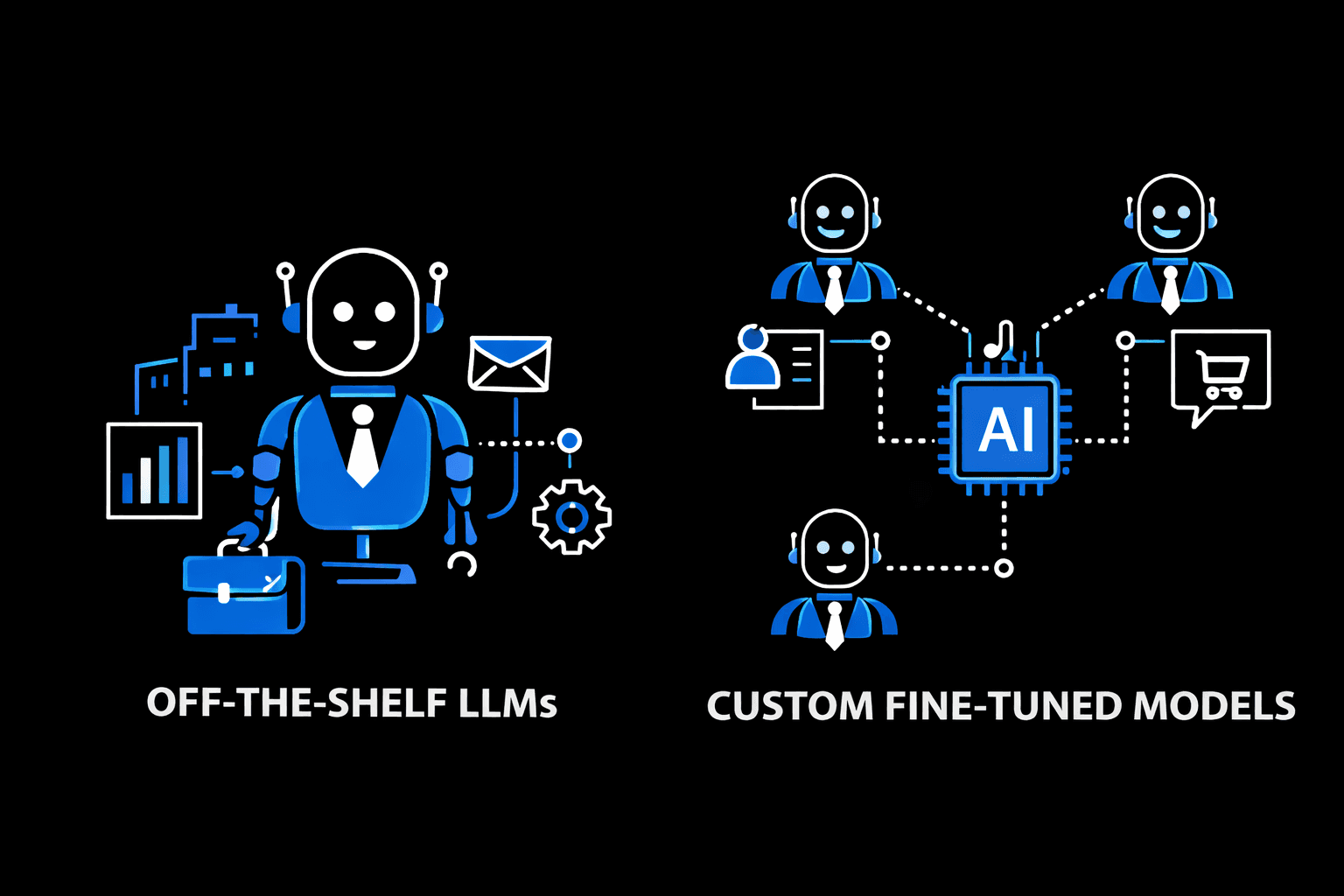
We have entered the era of the "Superworker Organization." As noted by industry analysts, the shift from passive to active intelligence is the most significant leap in productivity since the dawn of the internet. A standard LLM is a consultant; a custom AI agent is an employee.
While a standard generative model might draft a response to a customer complaint, an Autonomous AI Agent can:
Analyze the sentiment and history of the customer.
Search your internal database for the specific order status.
Cross-reference the refund policy in your legal knowledge base.
Issue a credit in your billing system.
Send a personalized resolution email—all without a human clicking "submit."
The Core Components of a Custom AI Agent
To build a production-grade agent, you must move beyond the "prompt box." A true agentic system requires four technical pillars:
1. The Reasoning Engine (The Brain)
This is the LLM (Large Language Model) that serves as the planning center. In 2026, many firms use "Small Language Models" (SLMs) for specific tasks to reduce latency, while reserving "Frontier Models" for high-stakes decision-making.
2. Memory Layers (The Context)
Short-term Memory: The context of the current conversation or task.
Long-term Memory: Utilizing Vector Databases to store past interactions and proprietary company knowledge, allowing the agent to "learn" from previous executions.
3. Tool Integration (The Hands)
Agents reach their full potential through "Function Calling." By connecting Custom AI Agents for Business to your existing software (Salesforce, HubSpot, SAP), you give the AI the ability to act upon its reasoning.
The Agentic Maturity Model: Four Levels of Autonomy
As you scale your agentic workforce, your initiatives will fall into one of four categories:
Level | Name | Characteristic | Example |
L1 | Assisted | Human prompts, AI performs a single task. | Writing a single email draft. |
L2 | Conditional | AI executes a workflow; Human approves each step. | Qualifying a lead and drafting a sequence. |
L3 | Autonomous | AI executes end-to-end; Human reviews the result. | Managing a 24/7 support queue. |
L4 | Strategic | Multi-agent "crews" manage entire business functions. | Autonomous supply chain re-ordering. |
Multi-Agent Orchestration: Managing Your Digital "Crew"
In 2026, the most successful implementations utilize Multi-Agent Systems (MAS). Rather than one giant agent trying to do everything, you deploy a "crew" of specialized workers.
The Manager Agent: Breaks down a high-level goal (e.g., "Launch a Q3 Marketing Campaign") into smaller tasks.
The Researcher Agent: Scours market data and competitor pricing.
The Creative Agent: Generates ad copy and visual assets based on the research.
The Compliance Agent: Ensures all assets meet legal and brand guidelines.
Frameworks like CrewAI, Microsoft AutoGen, and LangGraph have become the standard for orchestrating these interactions, ensuring that agents can "talk" to each other to resolve blockers.
The Governance Layer: Trust and Safety in Autonomous Systems
The #1 risk of 2026 is "Agent Sprawl"—thousands of autonomous agents running without centralized oversight. A secure Custom AI Agents for Business framework must include:
Boundary Enforcement: Strict permissions (RBAC) ensuring a marketing agent cannot access payroll data.
Auditability: A "Black Box" recorder for AI logic. If an agent makes a $50,000 mistake, you must be able to trace the "Chain of Thought" that led to that decision.
Human-in-the-Loop (HITL): Strategic "kill switches" and approval gates for high-value transactions.