Regulation: How Custom AI Agents Help Meet GDPR and HIPAA Compliance Standards
Learn how custom AI agents meet GDPR and HIPAA standards in 2026. Explore data minimization, BAA requirements, and secure enterprise AI implementation.
C3.1
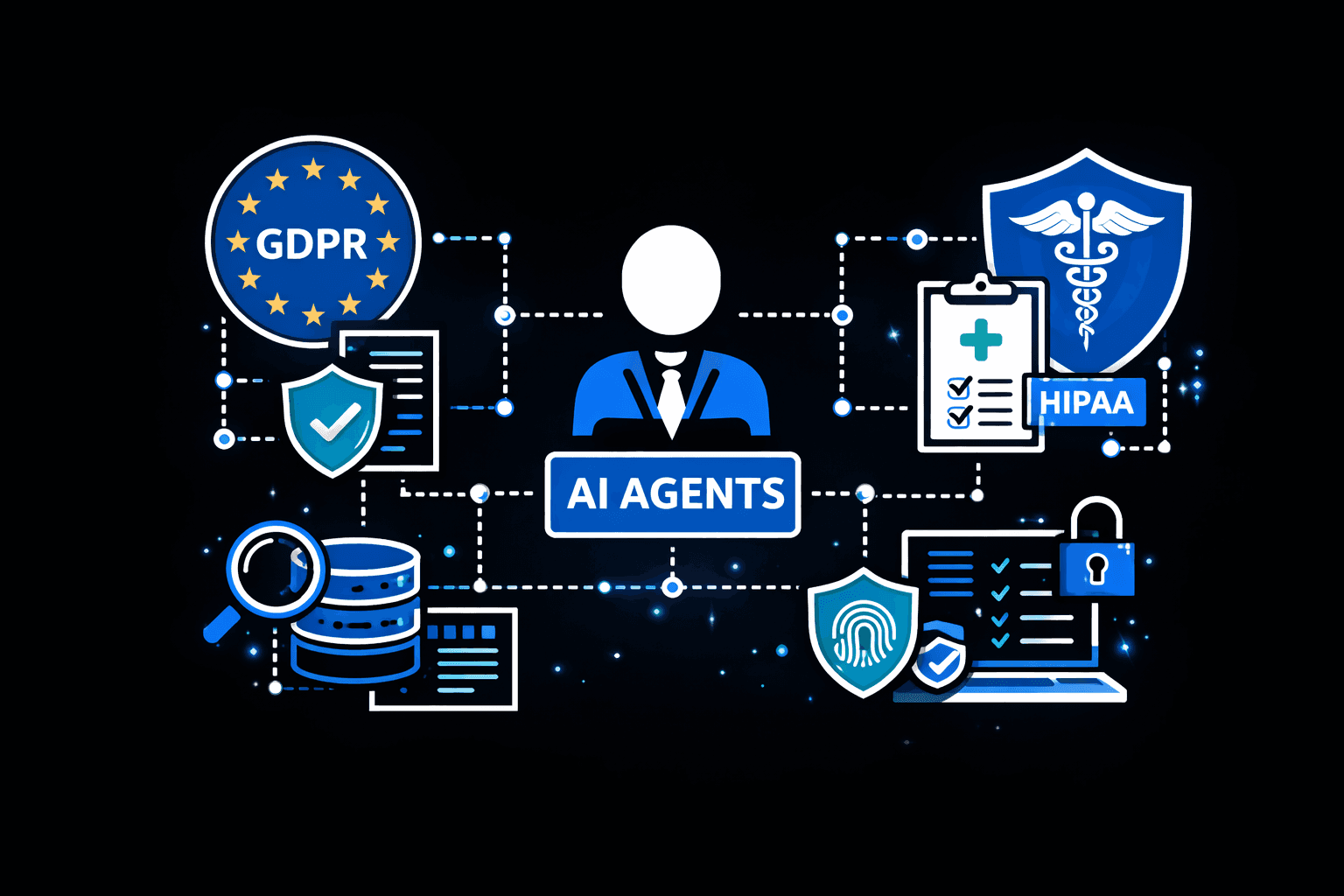
In the modern regulatory landscape, a Secure Enterprise AI Implementation is no longer just a technical hurdle—it is a legal requirement. As we move through 2026, global authorities have shifted their focus from general data protection to specific "Algorithmic Accountability." For organizations in regulated sectors like healthcare and finance, the challenge is clear: how do you deploy autonomous agents that reason across sensitive data without violating the fundamental tenets of GDPR or HIPAA?
At MindLink Systems, we argue that properly architected AI agents are not the threat to compliance, but the solution. By moving from static databases to "Agentic Governance," firms can enforce privacy policies at the execution layer, ensuring that every tool call and every generated response is filtered through a legal lens in real-time.
GDPR and the "Right to Explanation": Beyond Black-Box AI
The General Data Protection Regulation (GDPR) has always demanded transparency, but Article 22 specifically targets "automated individual decision-making." In 2026, regulators are increasingly skeptical of "Black-Box" models that provide outcomes without reasoning.
Engineering Data Minimization into Agentic Workflows
Under GDPR, you must only process data that is "strictly necessary" for the task. A Secure Enterprise AI Implementation achieves this through Prompt Scoping. Instead of giving an agent access to an entire customer profile, the system passes only the specific "chunks" of data required to answer the current query.
The Benefit: If an agent is handling a shipping inquiry, it never sees the user’s credit score or health history, even if that data exists in the same ecosystem.
Managing "Right to be Forgotten" in Vector Databases
One of the greatest technical challenges for LLMs is the "Right to Erasure" (Article 17). Traditional databases make deletion easy; however, data embedded into a Vector Database or used in a fine-tuned model is harder to "unlearn."
The MindLink Solution: We utilize Reference-Based RAG. Instead of storing raw PII in the vector space, we store unique pointers. When a user requests deletion, the reference is severed, rendering the vector "meaningless" and ensuring the agent can no longer retrieve or "remember" that individual’s data.
HIPAA Compliance for AI: Protecting PHI in Every Inference
In the United States, the Health Insurance Portability and Accountability Act (HIPAA) mandates that any system touching Protected Health Information (PHI) must adhere to strict administrative, physical, and technical safeguards.
The Non-Negotiable BAA: Liability in the AI Supply Chain
A Secure Enterprise AI Implementation in healthcare is impossible without a Business Associate Agreement (BAA). This contract legally binds the AI vendor to protect PHI with the same rigor as the healthcare provider.
Warning: Using a standard public LLM API without a signed BAA is a direct violation of HIPAA.
Zero-Data Retention vs. Local Fine-Tuning
To maintain compliance, we implement Zero-Data Retention (ZDR) protocols. In this architecture:
The agent receives a medical transcript.
The LLM processes the data to generate a summary.
The raw transcript and the summary are immediately flushed from the AI provider's volatile memory.
No data is used to "improve" the base model for other customers.
The "Compliance-as-Code" Framework for AI Agents
To scale Secure Enterprise AI Implementation, firms are moving away from quarterly audits toward "Continuous Compliance." This involves embedding the rules directly into the agent's code:
Goal-Change Gates: If an agent tries to change its mission (e.g., shifting from "schedule appointment" to "diagnose symptoms"), the system triggers a mandatory human-in-the-loop review.
PII/PHI Detectors: A secondary model scans every outgoing response for sensitive patterns (Social Security numbers, ICD-10 codes) and redacts them before the user sees the output.
2026 Audit Readiness: From Static Documents to Live Traces
Regulators in 2026 no longer accept "vague assurances." They demand Live Traces. Our architecture generates a durable, searchable record for every agent interaction:
Input Trace: What data was the agent given?
Reasoning Trace: What internal logic did the agent follow?
Tool Trace: Which APIs did the agent call and what was the response?
Output Trace: What was finally communicated to the human?
This level of transparency ensures that during a Data Protection Impact Assessment (DPIA) or a HIPAA audit, your organization can provide "Forensic Accountability" for every action your AI takes.
Summary: Compliance as a Competitive Moat
In 2026, the firms that win are not those with the fastest AI, but those with the most trusted AI. By building Secure Enterprise AI Implementation on a foundation of GDPR and HIPAA "Privacy by Design," you transform regulatory burden into a competitive advantage. You aren't just protecting data; you are protecting your brand.