Off-the-Shelf LLMs vs. Custom Fine-Tuned Models: A Cost-Benefit Analysis
Should you build or buy your AI? Compare costs of public APIs vs. custom fine-tuned models. Learn the token break-even formula for enterprise AI in 2026.
C1.5
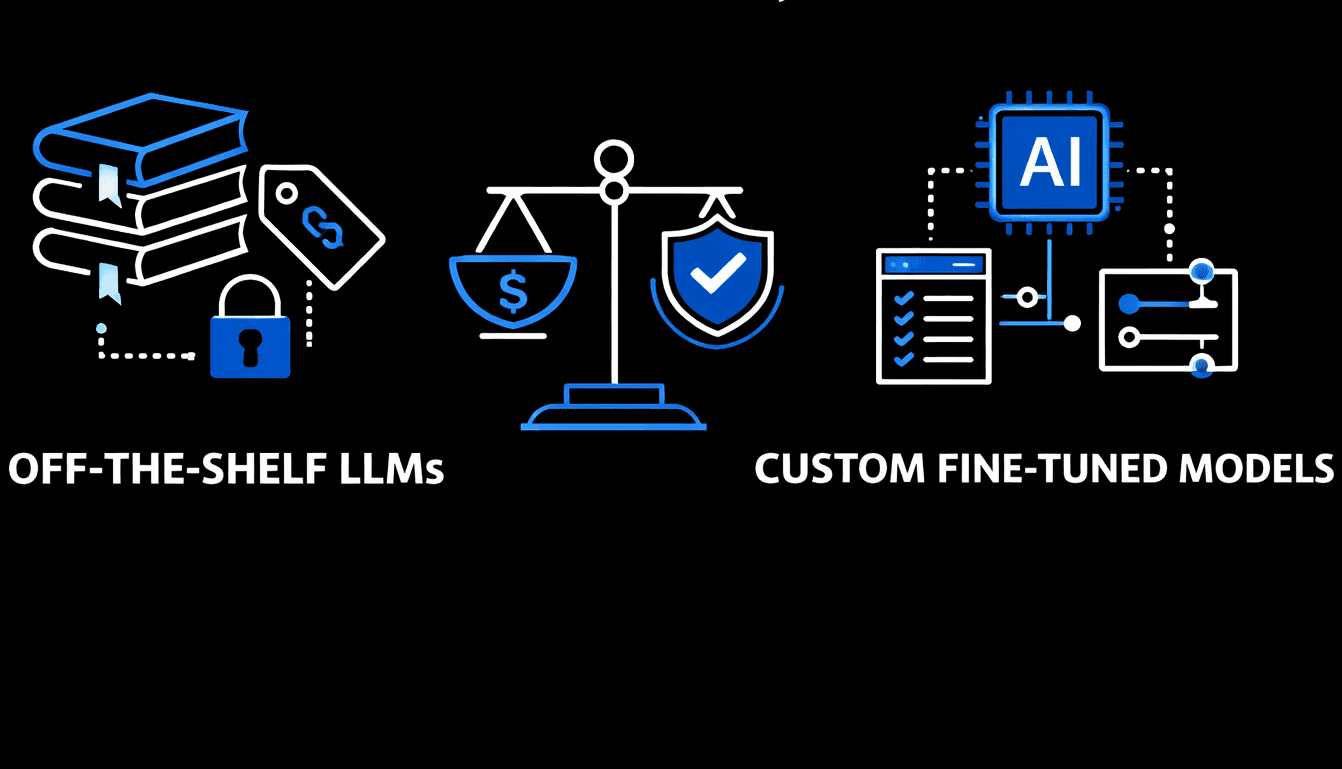
As we move deeper into 2026, the central pillar of a successful Enterprise Generative AI Strategy has shifted from "How do we use AI?" to "How do we own the intelligence we use?" For the enterprise, the decision to leverage a public API (Off-the-Shelf) versus developing a private, fine-tuned model (Custom) is no longer just a technical choice—it is a significant financial and strategic crossroads.
At MindLink Systems AI, we advise CTOs to view this not as a binary switch, but as a lifecycle progression. While public models offer immediate "frontier" capabilities, custom models represent a strategic asset that can significantly lower Total Cost of Ownership (TCO) once a workflow reaches scale.
The Strategic Tipping Point: Defining Build vs. Buy in 2026
The "Buy" route typically involves high-performance APIs like GPT-5.2 or Claude 4.5. These are general-purpose giants that excel at broad reasoning. The "Build" route—now significantly more accessible due to Parameter-Efficient Fine-Tuning (PEFT) techniques like LoRA—involves taking a high-quality open-source base (like Llama 4 or Mistral Next) and training it on your proprietary "Golden Datasets."
Option A: Off-the-Shelf Models (The API Economy)
Advantages: Speed to Market and Frontier Capabilities
For 90% of organizations, the Enterprise Generative AI Strategy starts here.
Zero Infrastructure: No GPUs to procure, no cooling systems to manage.
Frontier Logic: You gain immediate access to models that have been trained on trillions of tokens—reasoning capabilities that a custom mid-market model cannot yet match.
Scalability: Public APIs handle the "noisy neighbor" problems of bursty traffic effortlessly.
The Hidden Costs: Token Volatility and "Data Leaks"
However, the "API Tax" is real. In 2026, high-end reasoning models (e.g., GPT-5.2 Pro) can cost as much as $21.00 per 1M tokens. For an enterprise processing 100M tokens monthly across its customer support and legal departments, this results in an annual OpEx of over $25,000—just for the raw "intelligence." Furthermore, the risk of proprietary business logic being used to inadvertently train future public models remains a primary concern for the C-Suite.
Option B: Custom Fine-Tuned Models (The Sovereign Asset)
Advantages: Domain Precision and Long-term Margin Expansion
A custom model is a specialist. While a public LLM knows "everything," your fine-tuned model knows your brand voice, your SKU catalog, and your industry’s specific regulatory nuances.
Reduced Hallucinations: By narrowing the model's focus, you significantly increase the reliability of the output within a specific domain.
Latency Control: Hosted on a private "Neocloud" or on-premise hardware, custom models provide sub-100ms response times that public APIs often struggle to guarantee under load.
The Engineering Reality: PEFT, LoRA, and the TCO of Training
In 2026, "Building" does not mean $10M in training costs. Techniques like QLoRA allow enterprises to fine-tune models with billions of parameters for under $5,000 in compute costs. The real TCO lies in Data Engineering—the process of cleaning and labeling the "Golden Datasets" required for the model to learn.
Quantitative Comparison: The "Token Break-Even" Formula
To determine your path, use the MindLink Break-Even Formula:
$$V_{critical} = \frac{T_{fixed\_dev} + T_{infra\_annual}}{C_{api\_per\_token} - C_{self\_hosted\_per\_token}}$$
In 2026 market conditions, we find that the break-even point for a mid-market firm is typically 50M tokens per month. If your volume exceeds this, the savings from self-hosting a custom model will pay for its development and infrastructure within 12 to 14 months.
The Hybrid Solution: A Tiered LLM Architecture
The most sophisticated Enterprise Generative AI Strategy today is a Model Cascade:
The "Triage" Layer (Custom/Small): A small, fine-tuned 7B model (e.g., Mistral) handles 80% of routine queries at near-zero cost.
The "Expert" Layer (Off-the-Shelf/Large): If the triage model detects high complexity or ambiguity, the query is "escalated" to a frontier API like GPT-5.
The "Vault" Layer (Custom/Private): All queries involving sensitive PII or R&D data are routed exclusively to a private, air-gapped model.
Final Verdict: Which Path Fits Your 2026 Roadmap?
Metric | Off-the-Shelf (API) | Custom Fine-Tuned |
Setup Time | < 1 Day | 4–8 Weeks |
Initial Cost | Low ($0) | High ($50k - $150k) |
Cost per Query | High (Variable) | Low (Fixed) |
Security | Shared Responsibility | Absolute Sovereignty |
Task Accuracy | Generalist | Specialist |
Choose Off-the-Shelf if: You are in the "Pilot" phase or your use case requires broad, multi-domain reasoning.
Choose Custom if: You have high-volume, repetitive tasks; you require strict data privacy; or you want to build a proprietary asset that increases your company’s valuation.