Technical: Private LLM Deployment—Running High-Performance AI Without the Public Internet
Eliminate data egress risk. Learn the technical requirements for Private LLM Deployment, from NVIDIA NIM to air-gapped secure enterprise AI implementation.
C3.5
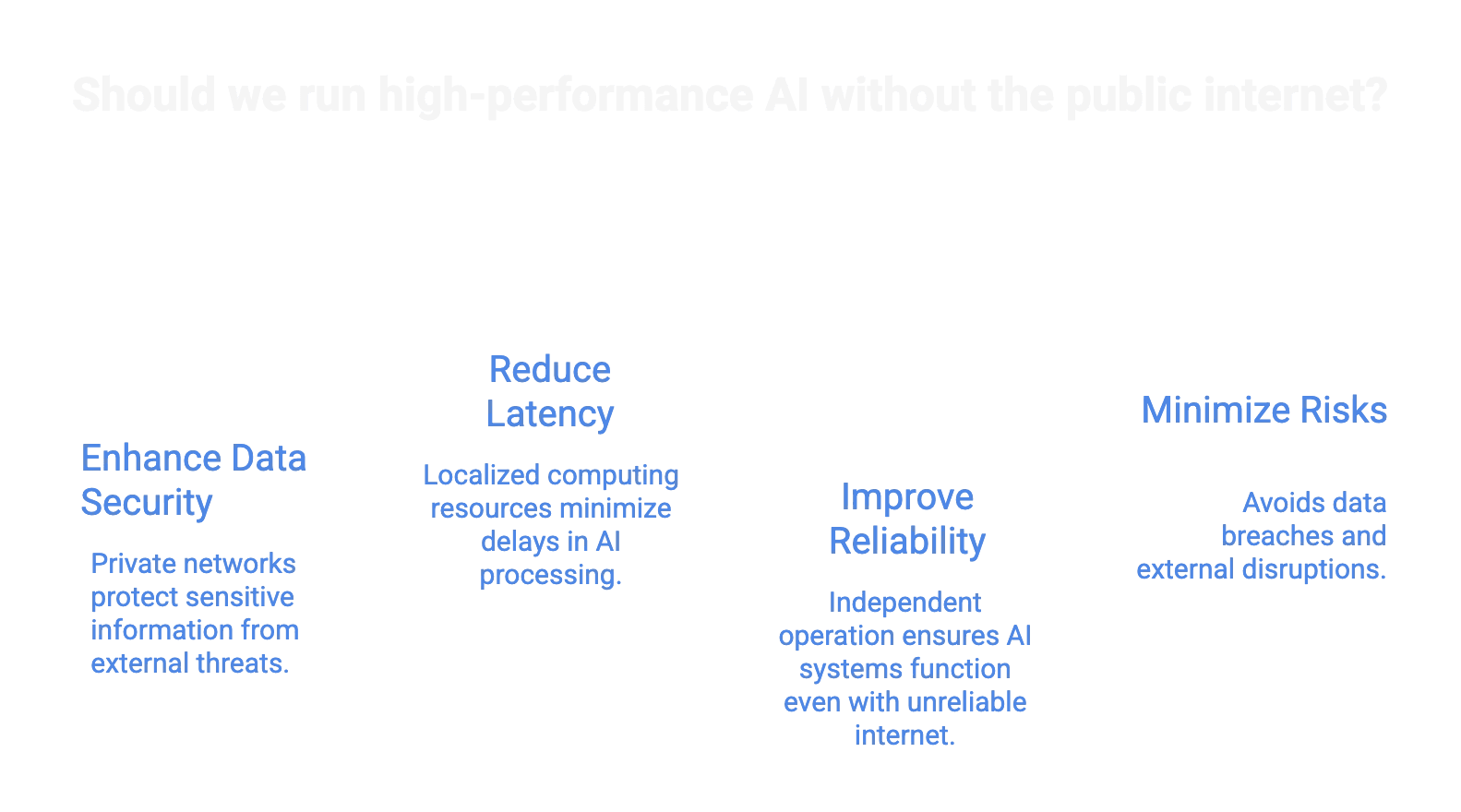
In the pursuit of a Secure Enterprise AI Implementation, the most formidable defense is the elimination of the external network altogether. While cloud-based APIs provided the initial spark for the generative AI revolution, 2026 has ushered in a "Great Repatriation." Enterprises are increasingly moving their most sensitive AI workloads off the public internet and into environments they fully control.
This shift is driven by a simple technical reality: in the era of agentic automation, the "perimeter" is no longer just your network—it is the model itself. By opting for a Private LLM Deployment, organizations can eliminate data egress risks, bypass the "noisy neighbor" latency of shared APIs, and ensure that their intellectual property never leaves their physical or virtual jurisdiction.
The End of the "Cloud-First" Default: Why Data Sovereignty Demands Localization
As we navigate 2026, "Data Sovereignty" has moved from a compliance checkbox to a board-level technology strategy. Global regulations like the EU AI Act and Canada’s Digital Sovereignty Framework now emphasize not just where data is stored, but where it is processed.
When you use a public API, your data—even if processed "ephemerally"—crosses jurisdictional boundaries. For a Secure Enterprise AI Implementation in sectors like defense, aerospace, or critical financial infrastructure, this transient exposure is an unacceptable risk. Private deployment ensures that the "compute moves to the data," rather than forcing sensitive data to travel to a third-party server.
Defining the Private AI Stack: On-Premise vs. Virtual Private Cloud (VPC)
There is no one-size-fits-all for private AI. Organizations generally choose between two primary architectures based on their risk tolerance and infrastructure capabilities.
1. The Fully Air-Gapped Model (Hardware-Enforced Isolation)
For the highest security requirements, the AI environment is physically disconnected from the internet.
Hardware: Local NVIDIA H200 or Blackwell clusters.
Update Mechanism: "Sneakernet" or secure internal repositories for model weights and software patches.
Use Case: National security, proprietary R&D, and offline industrial maintenance.
2. The Private Cloud / VPC Model (The Enterprise Standard)
The model runs within an organization's existing cloud account (e.g., AWS, Azure, or GCP) but inside a logically isolated sub-network.
Architecture: The LLM is deployed via Kubernetes (EKS/AKS) within a VPC. Communication with internal apps happens via private endpoints (PrivateLink), ensuring traffic never touches the public web.
Benefit: Combines the security of private ownership with the elastic scaling of the cloud.
Accelerating Local Inference: Hardware and Software for 2026
The historic barrier to Private LLM Deployment was the sheer cost of hardware. However, two major breakthroughs in 2025-2026 have leveled the playing field.
NVIDIA NIM: Microservices for Scalable Private AI
NVIDIA NIM (Inference Microservices) has become the "Easy Button" for private deployment. These are enterprise-grade containers that come pre-packaged with optimized inference engines (TensorRT-LLM). They allow IT teams to self-host models like Llama 3.1 or Nemotron in minutes, providing industry-standard APIs that look and feel like the public ones developers are used to.
Quantization and the Rise of "Beefy" Edge Computing
Modern techniques like NVFP4 and FP8 quantization allow high-parameter models to run on significantly smaller VRAM budgets. In 2026, a "Small" 30B parameter model, when properly quantized, can outperform much larger public models on specific domain tasks while running entirely on a high-end local workstation or a mid-sized local server.
The Technical Architecture of a Sovereign AI Gateway
In a Secure Enterprise AI Implementation, the "Gateway" acts as the traffic controller for your private models. A sovereign gateway provides:
Regional Routing: Automatically directing requests to the closest local model instance to minimize latency.
Local Audit Logging: Storing every prompt and response trace within your own SQL or NoSQL database for forensic review.
Hardware-Level Encryption: Utilizing Trusted Execution Environments (TEEs) to ensure that even the system administrators cannot inspect the data being processed inside the GPU’s memory.
Summary: The Strategic Value of Private AI Ownership
Moving to a Private LLM Deployment is an investment in "Future-Proofing." It shields your organization from vendor price hikes, API deprecations, and policy shifts. More importantly, it provides the ultimate guarantee: that your most valuable insights remain within your fortress.
When you own the infrastructure, you own the intelligence.