What is RAG (Retrieval-Augmented Generation) and Why Do Your Agents Need It?
Discover why RAG (Retrieval-Augmented Generation) is essential for Custom AI Agents for Business in 2026. Learn about vector DBs, grounding, and Agentic RAG.
C2.3
In the pursuit of a world-class Custom AI Agents for Business strategy, organizations often encounter a fundamental hurdle: Large Language Models (LLMs) are "frozen" in time. An LLM's knowledge is limited to the data it was trained on, which is often months or years out of date. Furthermore, it has no inherent access to your private company data—your proprietary price lists, technical manuals, or customer histories.
This is where Retrieval-Augmented Generation (RAG) comes in. In 2026, RAG has become the industry-standard architecture for ensuring that AI agents remain accurate, auditable, and grounded in real-time truth. Without RAG, an agent is merely guessing; with RAG, it is researching.
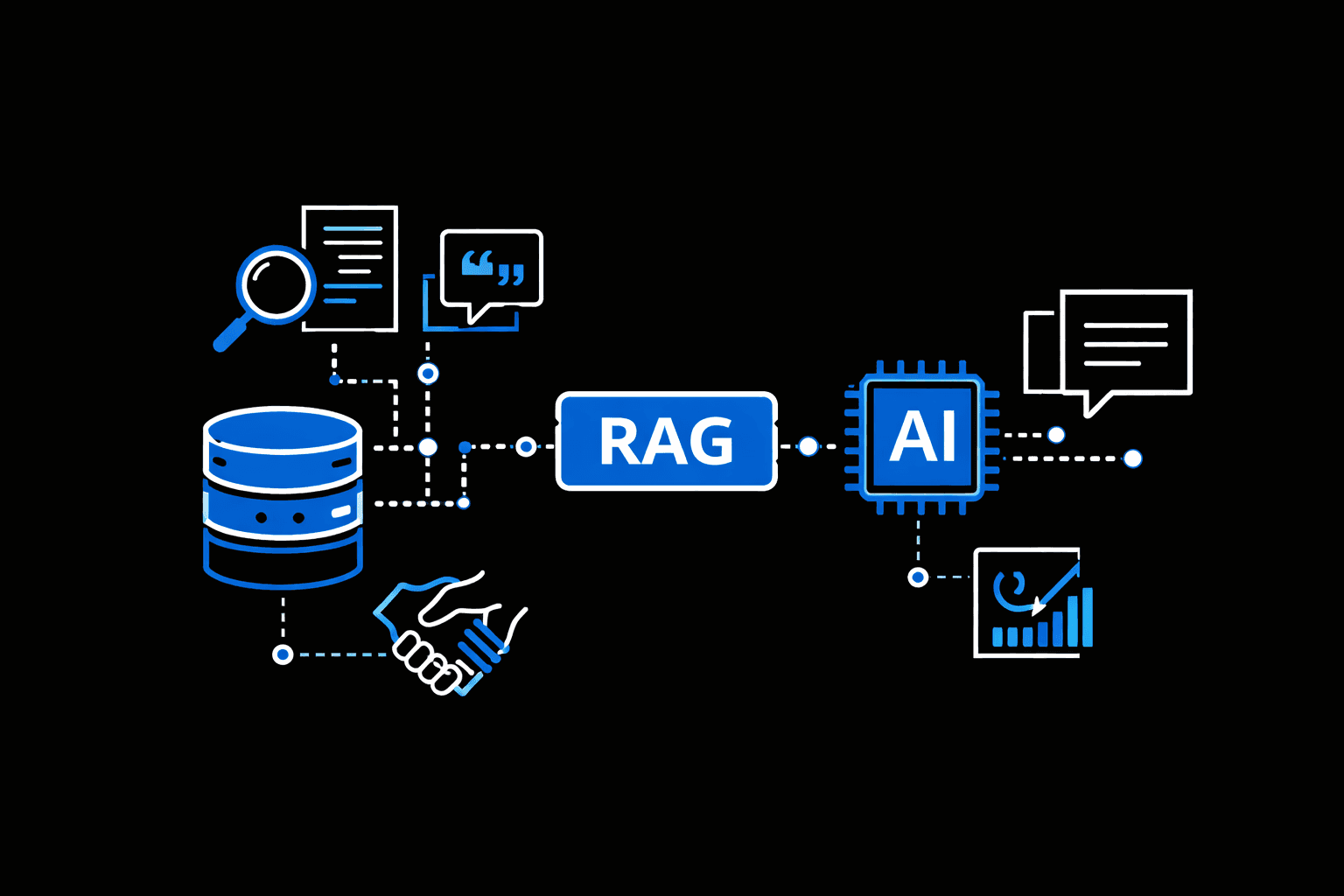
[Image showing the RAG workflow: User Query -> Search Vector DB -> Retrieve Context -> Combine with Prompt -> LLM Output]
The "Truth" Engine: Why LLMs Alone Are Not Enough for Business
Standard LLMs suffer from "Hallucinations"—the tendency to confidently state false information. For a Custom AI Agents for Business deployment, a hallucination isn't just a glitch; it’s a liability.
RAG solves this by providing the model with an "Open Book" exam. Instead of relying on its internal memory, the agent first searches a specific, trusted set of documents (your corporate "Knowledge Base") and uses that information to formulate its response. This ensures the output is:
Current: It uses the most recent documents uploaded.
Specific: It uses your company’s specific terminology and policies.
Source-Transparent: It can provide citations for every claim it makes.
Understanding the RAG Architecture: The 3-Step Loop
A production-grade RAG system follows a specific mathematical and logical sequence.
Step 1: Retrieval (Finding the Needle in the Haystack)
When a user asks a question, the system converts that query into a Vector Embedding—a numerical representation of the query's meaning. It then searches a Vector Database (like Pinecone, Milvus, or Weaviate) to find the most mathematically similar pieces of information.
Step 2: Augmentation (Providing the Context)
The retrieved "chunks" of data are then added to the original user prompt. This creates a "Rich Prompt" that looks something like this:
"Using only the following technical documentation [Document A, B, and C], answer the user's question about the H200 server configuration."
Step 3: Generation (Formulating the Answer)
The LLM reads the context and the question together. Because the answer is right in front of it, the model’s job changes from "remembering" to "summarizing and reasoning."
RAG vs. Fine-Tuning: When to Use Which?
A common question in Custom AI Agents for Business planning is whether to fine-tune a model or use RAG. In 2026, the answer is usually RAG for knowledge and Fine-tuning for behavior.
Feature | RAG | Fine-Tuning |
Updates | Real-time (add a doc) | Slow (requires retraining) |
Cost | Low (Compute for search) | High (GPU for training) |
Accuracy | High (Direct Citations) | Medium (Probabilistic) |
Best For | Fact-based tasks | Tone, Style, and Logic |
Agentic RAG: The 2026 Shift from Passive to Active Retrieval
As we move into 2026, "Basic RAG" is being replaced by Agentic RAG. In a basic system, the retrieval happens once. In an agentic system, the AI decides if it needs to retrieve more information.
Self-Correction and Multi-Step Reasoning
An Agentic RAG system can:
Evaluate its own search results: "I found information on the pricing, but not the discount tiers. I will search again."
Cross-Reference Sources: "The PDF says the warranty is 2 years, but the CRM says 3. I will flag this for a human."
This iterative loop is what makes Custom AI Agents for Business capable of handling complex, high-stakes enterprise workflows where "close enough" isn't good enough.
The Core Tech Stack: Vector Databases and Embeddings
To implement RAG, your infrastructure must support the storage of high-dimensional vectors. The relationship between a query $q$ and a document $d$ is often calculated using Cosine Similarity:
$$\text{similarity} = \cos(\theta) = \frac{\mathbf{q} \cdot \mathbf{d}}{\|\mathbf{q}\| \|\mathbf{d}\|}$$
In 2026, enterprises are moving toward Hybrid Search, which combines this mathematical similarity with traditional keyword search (BM25) to ensure that technical acronyms and specific product codes are never missed.
Summary: RAG as the Foundation for Trustworthy Agents
For any organization serious about a Custom AI Agents for Business strategy, RAG is not optional. It is the bridge between a generic "AI toy" and a specialized "Enterprise Tool." By grounding your agents in a proprietary, real-time knowledge base, you transform them into reliable, scalable members of your workforce.